

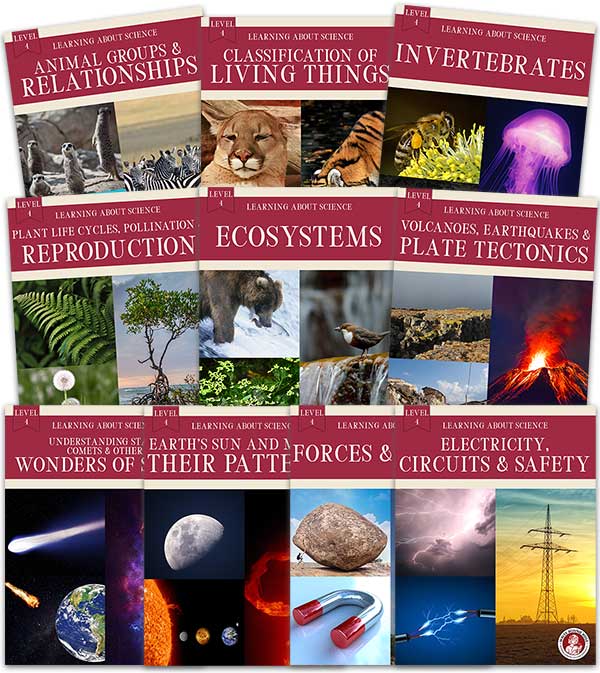
Learning About Science Level 4 Complete Collection
$55.00
Make science simple and engaging with bite-sized lessons in life, earth, and physical science! Students ages 8–13 will explore animals, plants, ecosystems, space, electricity, forces, and more—plus enjoy 10 interactive notebooks for drawing, labeling, and review.
For ages 8-13 | This is a digital only resource.
Published by: WriteBonnieRose
Learning About Science Level 4 Complete Collection
Give your upper elementary students a rich yet approachable science experience with this engaging collection. Students explore animal groups and classification, plant life cycles, ecosystems, invertebrates, volcanoes, earthquakes, plate tectonics, the sun and moon, electricity, forces and motion, and the wonders of space—all in clear, easy-to-digest lessons that eliminate the overwhelm of heavy textbooks.
Each unit is filled with tons of illustrations, review activities, and labeling exercises to make science come alive. Students will encounter more than 250 key vocabulary words while strengthening comprehension through activities they can personalize, sketch, and color.
The companion notebooks expand the learning with opportunities to draw, label, and sketch their own illustrations, making them the perfect extension for creative learners. Answer keys are included for both the main books and notebooks.
Other highlights include:
- Units designed in a simple, bite-sized format for flexible pacing
- English and metric measurements throughout
- Over 120 animals studied in the invertebrates unit alone
- Activities that reinforce concepts through diagrams, labeling, and review questions
- This resource is neutral in worldview (no discussion of origins or age of the earth), but families who would like to approach the material from a Creation perspective can access free downloadable discussion helps.
More on the Individual Units:
Animal Groups & Relationships:
Why do animals cooperate, and how is that different from symbiosis? In this unit, students explore fascinating animal relationships—mutualism, commensalism, and parasitism—while learning the difference between endoparasites and ectoparasites. With plenty of real-world examples, children will see the pros and cons of each relationship in action.
Classification of Living Things:
With millions of species on Earth, how do scientists keep track of them all? Through taxonomy! Students will uncover the basics of classification in both plants and animals, moving from domains all the way down to species. They’ll also learn what makes something “alive,” why scientific names matter, and the essential resources living things need to survive.
Earth’s Sun and Moon and Their Patterns:
The sun and moon influence life everywhere, yet their patterns can be puzzling. This unit explores the sun’s layers, sunspots, solar flares, and prominences before turning to the moon’s craters, maria, and mountains. Students will study Earth’s rotation, revolution, and tilt, along with the seasons, solstices, equinoxes, day and night, tides, and moon phases—finishing with solar and lunar eclipses explained clearly.
Ecosystems:
From Yellowstone to Monterey Bay, ecosystems are full of connections. Students discover how producers, consumers, and decomposers all work together in communities and populations. They’ll explore trophic pyramids, food webs, invasive species, endangered plants and animals, and see how even small actions can make a big impact.
Electricity, Circuits & Safety:
Beginning with a short history of electricity, this unit introduces students to static electricity, open and closed circuits, series and parallel circuits, and how electricity is generated, measured, and transmitted. They’ll also compare light bulbs and learn key safety tips for handling electricity at home.
Note: This unit explains concepts and principles but does not provide instructions for building circuits.
Forces and Motion:
Students are introduced to Newton’s laws of motion, friction, mass, acceleration, and gravity, along with the basics of magnetism. They’ll learn about types of magnets, magnetic fields, Earth’s magnetosphere, and electromagnetism—concepts that explain how the world moves and interacts.
Plant Life Cycles, Pollination & Reproduction:
Step into the world of plants, from towering vascular plants to simple algae and mosses. Students explore flowering plant anatomy, seed dispersal, and both sexual and asexual reproduction methods such as tubers, runners, and bulbs. They’ll also study fungi, lichens, molds, and mushrooms, discovering how each plays a role in life’s cycles.
Invertebrates:
Dive into the amazing world of animals without backbones. Students meet more than 120 creatures across 8 phyla, learn about their anatomy through detailed illustrations, and study 15 unique life cycles—from octopuses and starfish to crabs and squid. With over 250 illustrations, this unit is both rich and visually engaging.
Volcanoes, Earthquakes & Plate Tectonics:
Travel beneath Earth’s surface to uncover the forces that shape our planet. Students study the Earth’s layers, crusts, and plates before exploring faults, tsunamis, earthquakes, and volcanic activity. Historic eruptions and quakes bring the concepts to life, while diagrams of volcano types and plate boundaries make complex ideas easy to grasp.
Understanding Stars, Comets & Other Wonders of Space:
Students journey into space to learn about stars, planets, constellations, pulsars, nebulae, asteroids, meteors, comets, black holes, and more. This unit shines a light on the wonders of the universe and helps students see the difference between what’s in our solar system and what lies far beyond.
Discussion Helps:
Free downloadable guides are available to help families explore the topics in the Learning About Science Level 4 series from a Creation science worldview.
You must be logged in to post a review.

Reviews
There are no reviews yet.