

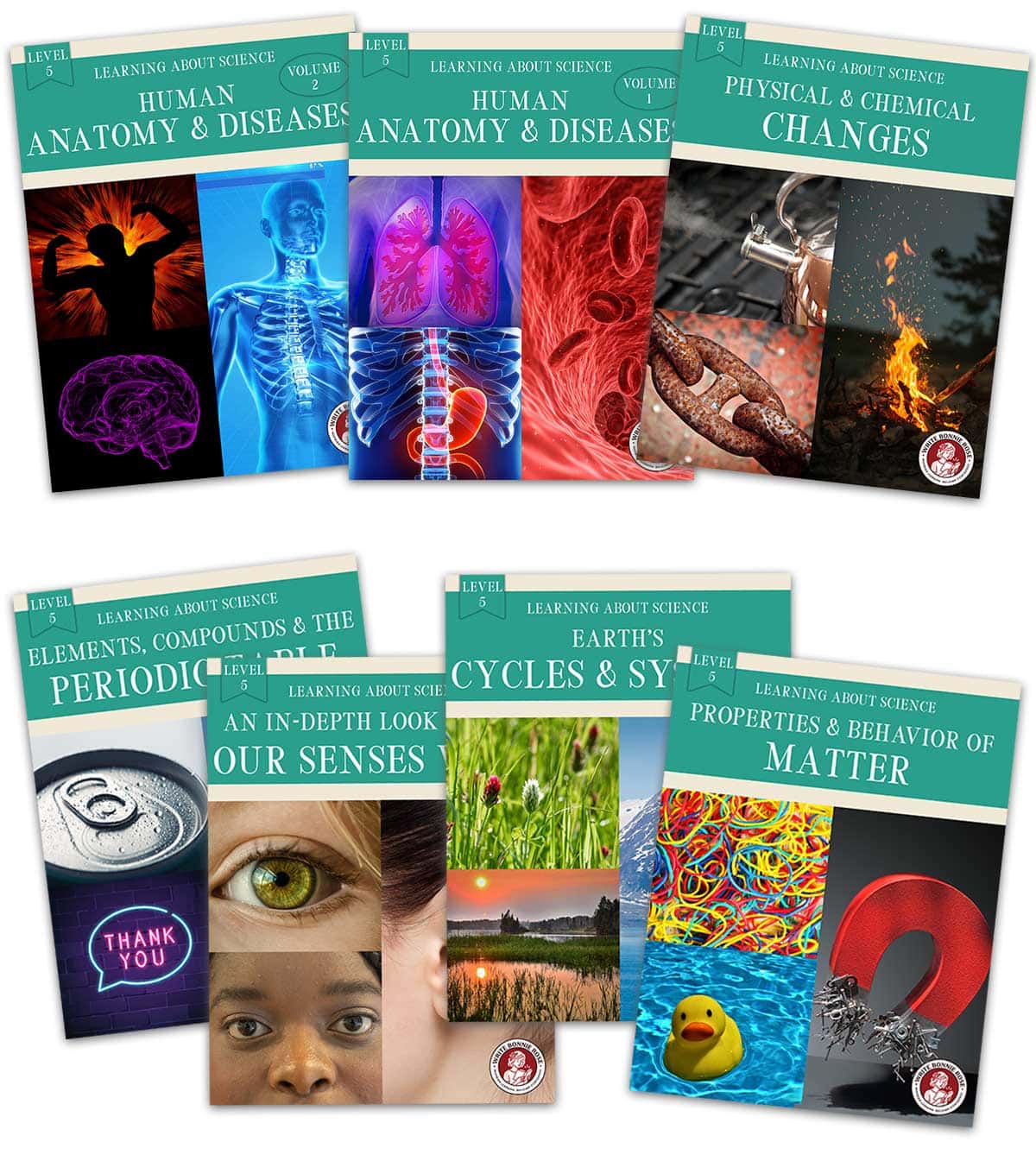
Learning About Science Level 5 Complete Collection
$45.00
Make science simple and engaging with bite-sized lessons in life, earth, and physical science! Students ages 8–13 will study human anatomy, earth’s cycles, the periodic table, matter, and more—plus enjoy interactive notebooks for drawing, labeling, and review.
For ages 8–13
Published by: Write Bonnie Rose
Learning About Science Level 5 Complete Collection
Give your upper elementary students a well-rounded, approachable science experience with this engaging collection. Students will explore human anatomy and diseases, earth’s layers and cycles, chemistry basics, physical and chemical changes, and the properties of matter—all taught in clear, easy-to-read lessons that avoid the overwhelm of traditional textbooks.
Each unit includes tons of illustrations, detailed diagrams, review questions, and labeling activities (including more than 50 anatomical diagrams) to help students grasp complex concepts. More than 200 key vocabulary words are covered, and the books can even be personalized as students color and sketch throughout.
The companion notebooks expand the learning with opportunities to draw, label, and illustrate what they’ve learned—perfect for creative learners who enjoy hands-on work. Answer keys are included for both the main books and notebooks.
Other highlights include:
- Units designed in a simple, bite-sized format for flexible pacing
- English and metric measurements used throughout
- Dozens of detailed anatomy diagrams covering multiple body systems
- Activities that reinforce comprehension through diagrams, labeling, and review
- Neutral in worldview (no discussion of origins or the age of the earth); free Creation-based discussion helps available for families who wish to use them
More on the Individual Units:
An In-Depth Look at How Our Senses Work: Why do your eyes see? Why does your tongue taste? What causes sinusitis, and why does it make it so hard to smell or even breathe? These are just a few of the answers students will learn the answers to as they take an in-depth look at how our senses work. They’ll learn the location and function of many different parts of the eyes, ears, nose, mouth, and skin as well as take a fun look at optical illusions.
Human Anatomy and Diseases, Pt. 1: Our bodies are incredibly complex. Each system has numerous parts that have to work together, and when one part is out of line, many other parts are affected. Through dozens of in-depth illustrations and diagrams, this anatomy unit looks at the parts of the respiratory, circulatory, digestive, excretory and urinary, and integumentary systems. It also looks at various diseases and conditions that affect these systems.
Human Anatomy and Diseases, Pt. 2: The complexity of the human body is astounding. When just one part is out of line, many other parts are affected. Through dozens of in-depth illustrations and diagrams, this anatomy unit looks at the parts of the skeletal, muscular, endocrine, immune and lymphatic, and nervous systems. It also looks at various diseases and conditions that affect these systems. Please note: this unit does not address reproductive organs that are part of the endocrine system.
Earth’s Cycles and Systems: Just as the human body is made of systems that work together, so is the earth. This earth science unit takes a look at the parts of these systems, the earth’s spheres, including the lithosphere, biosphere, hydrosphere, and atmosphere. The layers of the earth, the atmosphere, and the ocean are also studied. Following this section, the earth’s cycles are explored, including the water cycle, oxygen cycle, nitrogen cycle, and carbon cycle. Various aspects of the water cycle are explored including watersheds and water purification.
Elements, Compounds, and the Periodic Table: This unit is designed to introduce students to chemistry in a bite-sized way that is accessible and even fun. It starts by explaining what atoms are and what they are made of. Next, it explores elements and how they are arranged in the periodic table. The first twenty elements of the periodic table are looked at in detail; the remaining elements are looked at by class. Atomic number, mass number, and isotopes are also explored.
Physical and Chemical Changes: Everything around us changes, but scientists classify the ways matter changes as either a physical or chemical change. This unit helps students understand the difference between these two kinds of changes and explores common examples of each. Additional chemistry concepts such as boiling point, freezing point, melting point, condensation, sublimation, oxidation, and the first two laws of thermodynamics are also explored.
Properties and Behavior of Matter: Volume, density, buoyancy, transparency, viscosity, and elasticity are just a few of the properties of matter explored in this unit. Understanding the properties of matter and how different types of matter behave is critical for scientists and engineers to know what type of materials to use in various applications.
Discussion Helps: Free discussion guide to help you explore the topics in the Learning About Science Level 5 series from a Creation science worldview.
You must be logged in to post a review.

Reviews
There are no reviews yet.